Адреса и телефон

TCT Congress (Transcatheter Cardiovascular Therapeutics) is considered to be one of the major events in the world cardiology. Annually in November thousands of specialists gather to discuss the latest achievements in hi-tech treatment of cardiovascular diseases. It is necessary to pass a thorough selection of the expert committee to present your design at such a prestigious congress.
Thus, this year only six Russian specialists received an opportunity to deliver an oral presentation and Ivan Bessonov, MD, PhD, Scientific Researcher, X-ray and Endovascular surgeon of Tyumen Cardiology Research Center, branch of Tomsk NRMC, was among them. Ivan has become the first physician of the Center who made an oral presentation at this Congress.
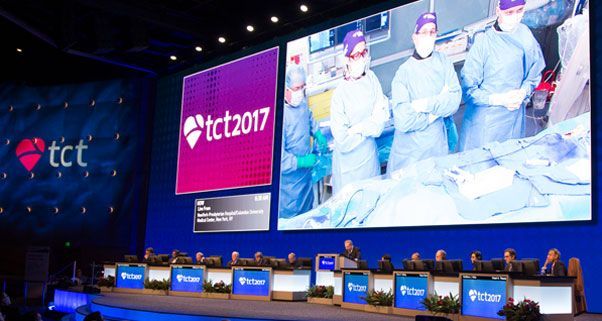
Ivan Bessonov described experience of providing hi-tech medical care to patients with acute myocardial infarction. “Our Center has a long-term experience of transcatheter operations. The main complication in treatment of myocardial infarction is atherosclerotic plaque which bursts in the vessel, and its components get inside, it leads to a thromb. There are many methods to solve the problem: a thromb is aspirated or is destroyed by the balloon. But the procedure often ends with stenting. Our experience shows that stent implantation is the most effective if no other procedures are performed. And it is unique: the installed stent prevents thromb spreading in the artery and destroys it at the same time. About 1500 operations were performed in our department”
This method is applied in many clinics but the fundamental analysis and description of the efficiency of the technology were presented by Tyumen Cardiology Research Center specialists themselves. As Ivan remarked, an important part of the presentation is questions and comments of the foreign colleagues. Many of them shared their opinion about the method and one Canadian cardiologist suggested a cooperated work in this field.
Besides, the committee selected poster presentations which were delivered by Stanislav Sapozhnikov, an interventional cardiologist from Tyumen Cardiology Research Center. One of them was a method to solve complicated problems which may appear in case of hi-tech vessel interventions using transradial access (radiation therapy). Some patients have a non-standard anatomy when the artery is arc-shaped of 360 degrees. In this case there is no possibility to move an instrument. “We demonstrated examples and action sequence of solving this problem. But these arcs are extremely dangerous – the artery can be damaged,” Stanislav says. He also showed complicated clinical cases and results of rotational atherectomy (rotablation), a procedure to provide a quick and effective care to the vessels seriously damaged by calcific plaques. Several years ago such patients could be saved only due to coronary artery bypass grafting, a very complicated intervention.
Doctor Sapozhnilov highlighted, “I would like to specify a breakthrough of our colleagues: Roman Tarasov, MD, PhD, an interventional cardiologist from Kemerovo, delivered his first presentation at the Congress. We are truly proud of him and Russian cardiology in general.”